Write the decimal expansion of 1/7. Is it terminating or non-terminating?
Step-by-step explanation:
- Divide 1 by 7: 1 ÷ 7 = 0.142857142857...
- The digits 142857 repeat infinitely.
- This is a non-terminating recurring decimal.
Conclusion:
Since the decimal repeats, 1/7 is a rational number. Fun Fact: The repeating block 142857 has cyclic properties. Try multiplying it by 2, 3, ..., 6!
Represent √5 on the number line geometrically.
Construction Steps:
1. Draw a number line and mark point O (0) and A (2 units).
2. At point A, draw a perpendicular and mark point B such that AB = 1 unit.
3. Connect OB. By Pythagoras theorem: OB² = OA² + AB² = 2² + 1² = 4 + 1 = 5 ⇒ OB = √5
4. Use a compass to draw an arc with radius OB and center O.
5. The arc intersects the number line at point P, which represents √5.
Visual Insight: This method uses a right triangle to geometrically construct irrational lengths.
Conclusion: Quotient = (x + 1)², Remainder = 0 Alternate Method: You can also use long division to verify.
Chapter 3: Coordinate Geometry
What is the Cartesian plane and how is it divided?
The Cartesian plane is a two-dimensional surface formed by two perpendicular number lines: the x-axis (horizontal) and the y-axis (vertical). These axes intersect at a point called the origin (0, 0). The plane is divided into four quadrants:
Quadrant I: (+x, +y)
Quadrant II: (−x, +y)
Quadrant III: (−x, −y)
Quadrant IV: (+x, −y)
The quadrants are numbered in an anticlockwise direction starting from the top-right.
What are the coordinates of a point and how are they written?
Coordinates are written as an ordered pair (x, y), where:
x is the horizontal distance from the origin (called the abscissa)
y is the vertical distance from the origin (called the ordinate)
For example, the point (3, −2) lies 3 units to the right of the origin and 2 units down.
In which quadrant does the point (−4, 5) lie?
The point (−4, 5) lies in Quadrant II because:
x is negative (−4), indicating a position to the left of the origin
y is positive (5), indicating a position above the origin
Quadrant II contains all points where x is negative and y is positive.
What are the coordinates of the origin?
The origin is the point where the x-axis and y-axis intersect. It serves as the reference point for all other coordinates on the plane. Its coordinates are always (0, 0).
This means there is no horizontal or vertical displacement from the center.
Chapter 4: Linear Equations in Two Variables
Write the standard form of a linear equation in two variables.
Standard Form: Ax + By + C = 0
- A, B, and C are real numbers
- A and B ≠ 0 (to ensure both variables are present)
Example: 2x + 3y - 6 = 0
Find two solutions of the equation 2x + 3y = 6.
Solution 1: Let x = 0 ⇒ 2(0) + 3y = 6 ⇒ y = 2 Solution 2: Let x = 3 ⇒ 2(3) + 3y = 6 ⇒ y = 0
Solutions: (0, 2) and (3, 0)
Draw the graph of the equation x + y = 4.
Choose values:
- x = 0 ⇒ y = 4
- x = 2 ⇒ y = 2
- x = 4 ⇒ y = 0
Plot: Points (0,4), (2,2), (4,0) Graph: Draw a straight line through these points.
If x = 1, find the value of y in the equation 3x + 2y = 7.
Write a linear equation whose graph passes through the points (0, 2) and (2, 0).
Find slope:
m = (0 - 2)/(2 - 0) = -1
Use point-slope form: y - y₁ = m(x - x₁)
⇒ y - 2 = -1(x - 0) ⇒ y = -x + 2 Standard form: x + y = 2
Chapter 5: Linear Inequalities
Solve: 3x − 5 < 7
To solve the inequality 3x − 5 < 7, follow these steps:
Add 5 to both sides to isolate the term with x:
3x − 5 + 5 < 7 + 5 → 3x < 12
Divide both sides by 3 to solve for x:
3x ÷ 3 < 12 ÷ 3 → x < 4
Final Answer: x is any number less than 4.
✅ This means x can be 3.9, 0, −5, etc., but not 4.
Graph the inequality x ≥ 2 on the number line.
To graph x ≥ 2:
Place a solid dot at x = 2 to show that 2 is included in the solution.
Shade the number line to the right of 2 to represent all values greater than or equal to 2.
Visual cues:
Solid dot → the number is included (≥ or ≤)
Arrow or shading → shows the direction of the inequality
🧠 Example values that satisfy x ≥ 2: 2, 3, 10, 100...
Is x = −1 a solution of the inequality 2x + 3 > 0?
To check if x = −1 is a solution to 2x + 3 > 0, substitute −1 into the inequality:
2(−1) + 3 = −2 + 3 = 1
Since 1 > 0, the inequality is true.
✅ Conclusion: x = −1 is a solution to the inequality.
Chapter 6: Introduction to Euclid's Geometry
What is the origin of the word 'geometry'?
The word 'geometry' comes from the ancient Greek words:
geo meaning “earth”
metrein meaning “to measure”
🔍 Interpretation: Geometry originally referred to measuring land and physical space.
State Euclid’s first postulate.
“A straight line may be drawn from any one point to any other point.”
✏️ This means that for any two distinct points, there exists exactly one straight line connecting them.
What is a point according to Euclid?
“That which has no part.”
📌 A point has no length, width, or thickness. It represents a precise location.
What does Euclid’s fifth postulate state?
“If a straight line falling on two straight lines makes the interior angles on the same side less than two right angles, then the two lines, if extended indefinitely, meet on that side.”
🔍 This describes how lines behave when intersected by a transversal.
Chapter 7: Lines and Angles
State the vertically opposite angles theorem.
When two lines intersect, the angles opposite each other are equal. Example: If ∠A and ∠B are opposite, then ∠A = ∠B
If two angles are supplementary and one is 65°, find the other.
Supplementary angles sum to 180°:
180° - 65° = 115°
Define a linear pair of angles.
Two adjacent angles whose non-common arms form a straight line. Sum: 180°
Chapter 8: Triangles
State the Pythagoras theorem.
In a right triangle: (Hypotenuse)² = (Base)² + (Height)² Example: If base = 3, height = 4 ⇒ hypotenuse = 5
Prove that angles opposite equal sides of a triangle are equal.
If AB = AC, triangle ABC is isosceles.
By congruence (SAS or SSS), ∠B = ∠C Conclusion: Angles opposite equal sides are equal
What is the sum of interior angles of a triangle?
Always: 180°
Chapter 9: Quadrilaterals
Define a parallelogram.
A quadrilateral with both pairs of opposite sides parallel and equal. Examples: Rectangle, Rhombus
State the angle sum property of a quadrilateral.
Sum of interior angles = 360°
If one angle of a parallelogram is 70°, find its adjacent angle.
Adjacent angles in a parallelogram are supplementary:
180° - 70° = 110°
Chapter 10: Circles
Define a chord of a circle.
A chord is a line segment that joins any two points on the circumference of a circle.
Note: The longest chord in a circle is the diameter, which passes through the center.
State the angle subtended by a diameter at the circle.
A diameter subtends a right angle (90°) at the circumference of the circle.
Why? This is a special case of the angle in a semicircle theorem.
If A and B are endpoints of the diameter and C is any point on the circle forming triangle ABC, then ∠ACB = 90°.
What is the relation between radius and diameter?
The diameter is twice the radius: Diameter = 2 × Radius
Example: If radius = 5 cm, then diameter = 10 cm.
Chapter 11: Statistics
Define mean of a data set.
The mean is the average value of a data set. Mean = (Sum of all observations) ÷ (Number of observations)
Example: For data 2, 4, 6 ⇒ Mean = (2 + 4 + 6)/3 = 12/3 = 4
Find the mode of: 2, 3, 4, 4, 5, 4, 6
The mode is the value that occurs most frequently.
In the given data: 4 appears three times.
Answer: Mode = 4
What is the median of: 5, 7, 9, 11, 13?
The median is the middle value when data is arranged in order.
Ordered data: 5, 7, 9, 11, 13
Middle value = 9
Answer: Median = 9
Chapter 12: Probability
Define probability.
Probability measures the likelihood of an event occurring. Probability = (Number of favorable outcomes) ÷ (Total number of outcomes)
Note: Probability values range from 0 to 1.
What is the probability of getting a head when tossing a coin?
A coin has two outcomes: Head and Tail.
Favorable outcome = Head
Total outcomes = 2
Probability:1/2
Find the probability of getting an even number when rolling a die.
A die has 6 faces: 1, 2, 3, 4, 5, 6
Even numbers = 2, 4, 6 ⇒ 3 favorable outcomes
Total outcomes = 6
Probability:3/6 = 1/2
Chapter 7: Lines and Angles
State the vertically opposite angles theorem.
When two lines intersect, the angles opposite each other are equal. Example: If ∠A and ∠B are opposite, then ∠A = ∠B
If two angles are supplementary and one is 65°, find the other.
Supplementary angles sum to 180°:
180° - 65° = 115°
Define a linear pair of angles.
Two adjacent angles whose non-common arms form a straight line. Sum: 180°
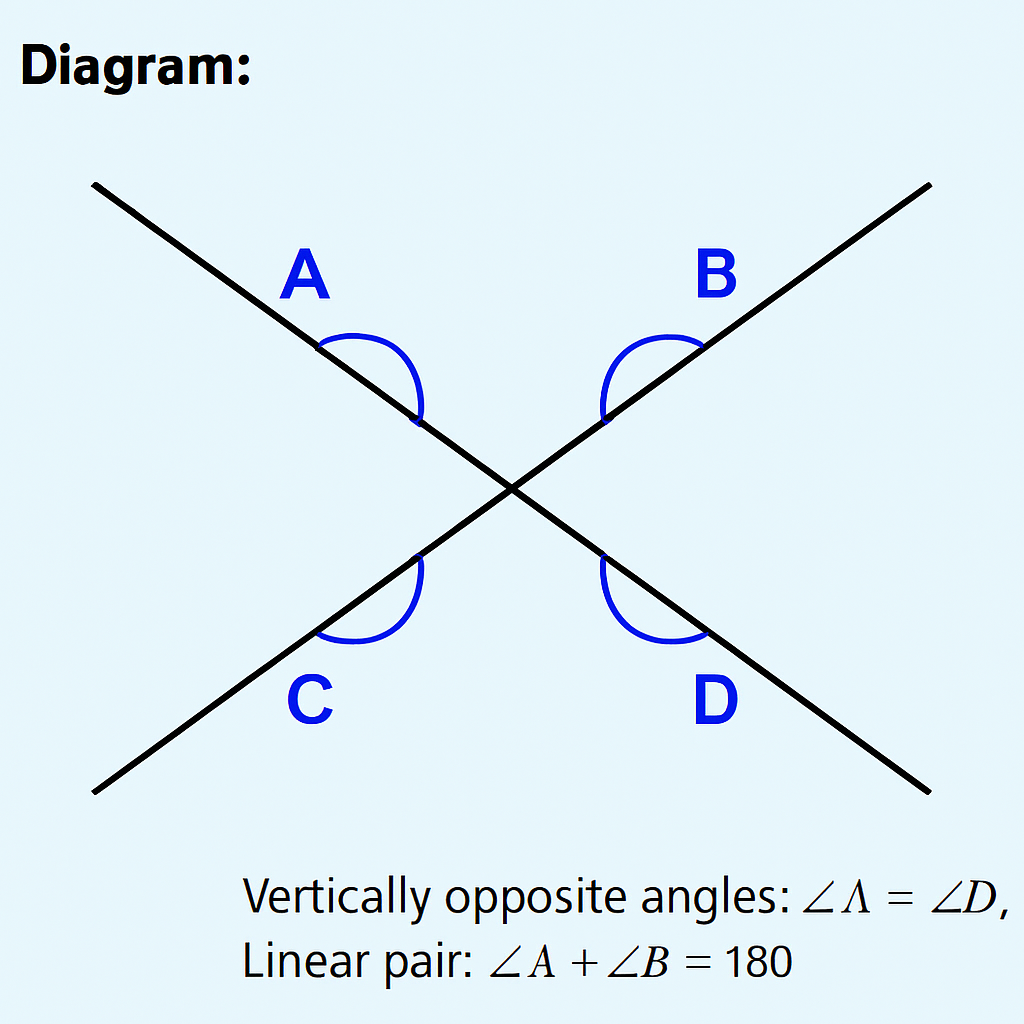
Elaborative explanation with diagram
1. Vertically Opposite Angles:
When two lines intersect, they form two pairs of vertically opposite angles.
These angles are equal in measure.
2. Supplementary Angles:
Two angles whose measures add up to 180°.
Example: If one angle is 65°, the other is 115°.
3. Linear Pair:
A pair of adjacent angles formed when two lines intersect.
Their non-common arms form a straight line, and their sum is 180°.
Diagram:
This diagram illustrates vertically opposite angles, supplementary angles, and linear pairs.